Legend has it that Irish monks were the first to settle in the Faroe Islands, but that Norse Vikings displaced them. Recordings of the event comes from the book “De mensura Orbis terrae” (On the measurement of the circumference of the earth), written by the Irish monk, Dicuil, in the year 825 ADE, not long after, the events took place. Therefore, the Norse landnam or land taking in the Faroe Islands is supposed to have taken place around this time.
Dicuil writes i.a. – and it is assumed that he is referring to the Faroe Islands: “Here hermits have lived a hundred years ago, but now there are none left, because the Vikings have driven them away – all that remains is a lot of sheep and seabirds.”
Thus we meet Grímur Kamban, said to be the first settler, who came here in about the year 825, and it has always been the belief among the Faroese that he disembarked at Funningur.
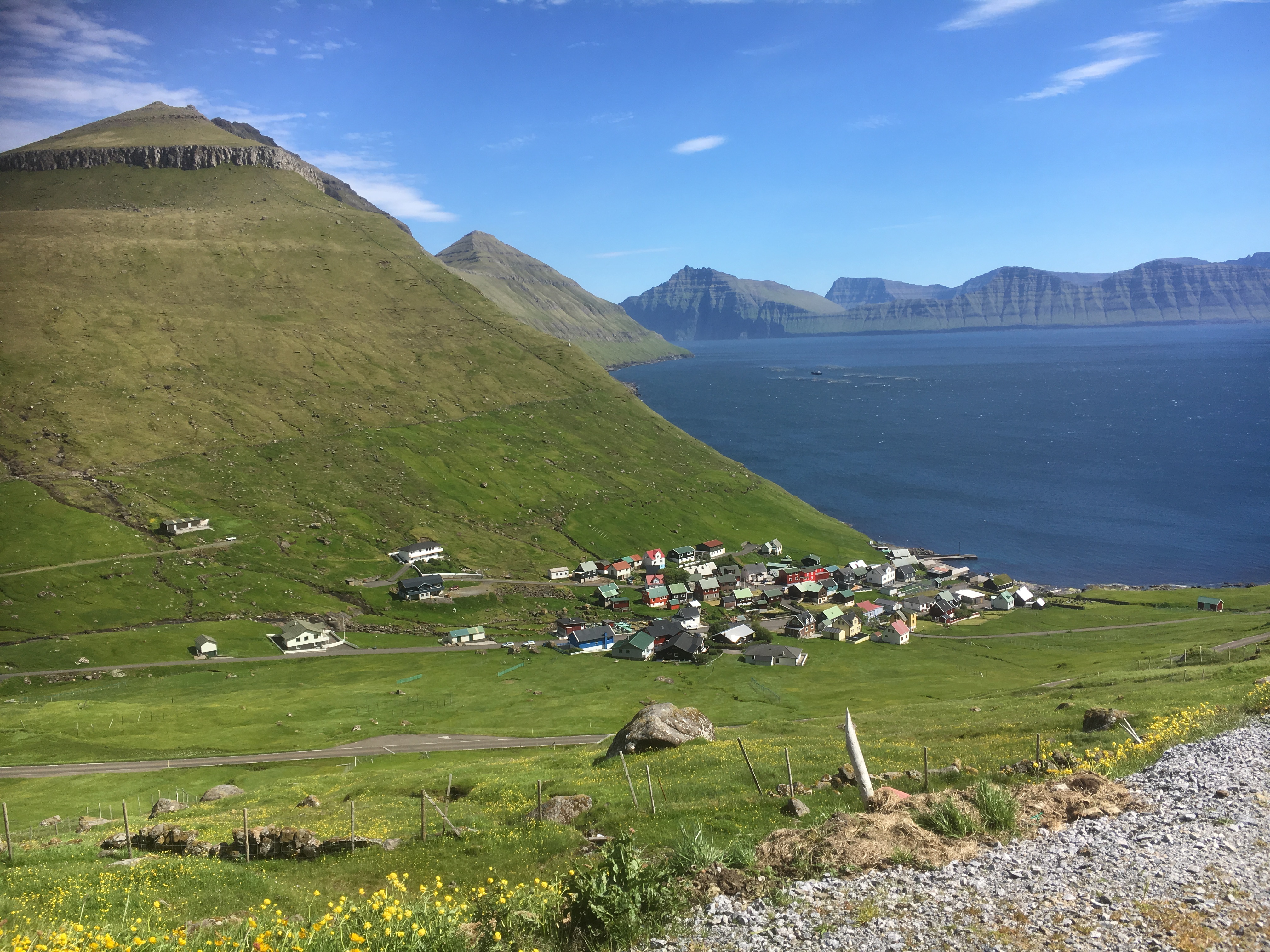
Funningur, this beautiful, hidden place between Djúpini (literally meaning “the Deep” – i.e. the waters between Norðuroyggjar – the Northern Islands – and Eysturoy – the East island), by the peaceful open Funning fjord and surrounded by the islands’ highest mountain.
What is to be found in Funningur and what does the name say about the place?
In the book “Føroyinga søga” (The story of the Faroese) it is told that the settlement period or the “landnam” – land taking – in the Faroe Islands took place in Funningur, and that the settlement got its name from the event that land was found (Funning – in English finding or find). The first named person to set foot on the islands was Grímur Kamban. Even his name is interesting, as Grímur is a Norse name, while Kamban is Celtic and means “the lame one”. This indicates, what science has later confirmed with various genetic tests, that the Faroese and Icelanders are as much of Celtic as of Norse origin—especially the women.
Funningur is a typical Faroese village where clusters of houses cling to the mountain side close to the coast on either side of a fresh water stream and surrounded by rich grasslands. Funningur was a perfect find for the Vikings, who looked at settlement with different eyes, than we do today: They had easy access to sea fishing, good farming opportunities and lots of fresh water for the household. An ideal place to settle down with families, and cultivate new land.
They most likely built boathouses close to the sea and longhouses with cowsheds and other outhouses. They have preserved their ability to build boats and made most of their Norse carpentry skills. There is a clear distinction between infield and outfield with stone wall fences, which shows that time and hourly wages did not have the same importance then as now.
People have lived in Funningur since the land taking period, i.e. the Norse invasion, which makes both the history, as well as the cultural evidence, both rich and interesting.
